

There’s a scene in Harry Potter that unintentionally explains modern employee retention better than most management frameworks.
Dobby, the house-elf, is loyal to the point of self-destruction, bound to a household not by joy but by obligation. He shows up, does the work, absorbs the pressure, and flinches when he makes a mistake. And when Harry Potter finally gives him a sock, a symbolic act of recognition and autonomy, Dobby is free. Not just legally. Emotionally free.
The parallel to modern employment is uncomfortable but precise.
For decades, many organizations benefited from a version of loyalty that looked remarkably similar: employees who stayed through exhaustion, absorbed emotional strain, and treated endurance as professionalism. The difference is that modern employees are no longer structurally bound to companies in the same way.
In 2026, workers don’t wait years for permission to leave. They update their LinkedIn, take a few recruiter calls, and quietly disengage long before resignation becomes official.
This is the shape of modern employee turnover. Not a dramatic walkout. Not a resignation speech. Just a quiet decision, made somewhere between a performance review that said nothing and a one-on-one that never happened.
What makes this dangerous is that organizations usually catch retention collapse far too late, after the behavioral signals have already normalized inside the culture.
Employees are cycling through roles faster than ever, disengaging before they depart, and treating loyalty as conditional – because in most workplaces, it has been exactly that.
The pre-turnover state
The most important retention problem in 2026 isn’t resignation itself. It’s what happens before it.
The pre-turnover stage describes the period where employees remain operationally present while emotionally and cognitively disengaging from the organization. Productivity may still appear stable. Deadlines may still be met. But initiative declines, trust erodes, and discretionary effort quietly disappears.
This is why many organizations feel blindsided by turnover spikes. They mistake visible retention for genuine commitment.
Most employees don’t quit suddenly. They resign emotionally first.
What makes this especially critical is that it is not only a cultural or behavioral issue. It is also economically significant. Different studies estimate that between 42% and 75% of turnover is preventable through known, documented, and relatively low-cost interventions. The causes are not mysterious. The levers are not hidden. The ROI is measurable.
Which means the real problem is rarely a lack of solutions. It is a failure to detect the signal early enough to act on it.
Signs of pre-turnover disengagement
- declining participation in meetings and discussions
- emotional flatness during one-on-ones
- reduced initiative and creative contribution
- slower response patterns and communicational withdrawal
- growing detachment from team goals
- increased focus on external opportunities and networking
- lower tolerance for organizational friction
By the time resignation becomes official, the departure process is often already months old.
What is the employee retention rate?
Before diving into the numbers, it’s worth establishing exactly what we’re measuring – because “employee retention” is one of those terms that means something precise to a data analyst and something vague to everyone else.
Employee retention rate is the percentage of employees who remain with an organization over a given period, typically measured annually. It reflects an organization’s ability to keep its workforce stable, engaged, and committed over time.
How it’s calculated:
Employee Retention Rate = ((Employees at End of Period − New Hires During Period) ÷ Employees at Start of Period) × 100
So if you started the year with 200 employees, hired 20, and ended with 190, your retention rate would be: (190 − 20) ÷ 200 × 100 = 85%.
What is considered a healthy employee retention rate?
A healthy employee retention rate is approximately 90%, meaning an annual turnover rate of round 10%. Anything below 80% is considered a serious retention problem requiring immediate strategic attention.
Retention vs Turnover: a quick contrast
These two metrics are inverse expressions of the same reality – but they carry different strategic weight:
| Metric | What it measures | Formula |
| Retention rate | % of employees who stayed | (Retained ÷ Starting headcount) × 100 |
| Turnover rate | % of employees who left | (Departures ÷ Starting headcount) × 100 |
It’s also important to distinguish between voluntary turnover (employees who choose to leave: resignations or job changes) and involuntary turnover (layoffs, terminations, role eliminations). Voluntary turnover is the metric that most directly reflects the quality of employee experience – and it’s the one driving the 2026 retention crisis.
Employee retention statistics 2026: The key numbers
The data behind employee retention in 2026 tells a surprisingly coherent story. Across industries, company sizes, and labor markets, the same pattern appears repeatedly.
Employees are not primarily leaving because they found marginally higher salaries elsewhere. They are leaving because the psychological cost of staying has exceeded the financial risk of leaving.
Global turnover cost
Voluntary employee turnover costs the global economy $2.9 trillion every year. In 2024 alone, US companies spent an estimated $900 billion filling positions vacated by workers who chose to leave voluntarily. This is no longer a normal operational expense. It is increasingly the financial consequence of organizational instability.
More than half the workforce is watching the market
Gallup research found that 51% of employees are actively looking for new opportunities. Separate surveys show even higher numbers among younger workers and knowledge-sector employees. The implication is uncomfortable. Many organizations are operating with workforces where at least half the employees are psychologically open to leaving.
Tenure decline
Average employee tenure has slid from 4.5 years in 2022 to 4.2 years in 2024 – and the trend shows no signs of reversing. Organizations now have less time to recover hiring and training investments, making early engagement more critical than ever.
Retention is HR leaders’ top priority
65% of HR leaders say hiring and retention are a top strategic priority for 2026, reflecting a broader move away from pure acquisition toward stabilizing existing talent. The talent market is increasingly defined by retention rather than recruitment as the primary competitive battleground.
Global engagement remains critically low
According to Gallup’s State of the Global Workplace report, only 23% of employees globally describe themselves as engaged. That means the overwhelming majority of workers are either passively disconnected or actively disengaged. Retention problems rarely begin with resignations. They begin with disengagement becoming culturally normal.
Employee turnover statistics by industry
Employee turnover rates are not evenly distributed across the economy. Some industries lose people gradually, almost predictably. Others operate in a near-permanent state of replacement hiring.
Understanding where your industry sits changes how you interpret every retention benchmark that comes after it.
| Industry | Annual voluntary quit rate (2024) | Stability rating |
| Government | ~9.6% | Most stable |
| Health care & social assistance | ~26.4% | Moderate-high risk |
| Information / technology | ~16.8% | High cost per departure |
| Accommodation & food services | ~49.2% | Extreme volatility |
- Government remains the most stable major employment sector. Structured advancement systems, long institutional tenure, and benefit-linked career paths create an environment where employees tend to stay longer than almost anywhere else in the economy. The trade-off is flexibility. The reward is retention.
- Healthcare faces a different kind of pressure entirely. The turnover problem is less about compensation than exhaustion. Staffing shortages, emotional fatigue, unclear role boundaries, and relentless workload intensity continue pushing attrition well above healthy benchmarks in many healthcare organizations.
- Technology no longer shows the same hiring frenzy that defined the post-pandemic years, but retention remains fragile. Departures inside tech are disproportionately expensive because they rarely take only labor with them. They take product knowledge, workflow continuity, customer context, and institutional memory. High salaries do not necessarily create loyalty. Often, they simply increase mobility.
- Hospitality exists in a category of its own. Annual turnover in the accommodation and food service sectors regularly exceeds 70%, creating an environment where some employers effectively rebuild large parts of their workforce every year. The result is a near-continuous cycle of onboarding, training, understaffing, and operational reset.
The percentages change by industry. The underlying pattern rarely does.
Poor management. Stalled growth. Burnout. Weak communication. Low organizational trust. Different sectors express the problem differently, but the structural causes behind employee turnover remain surprisingly consistent across almost all of them.
Why employees leave: The emotional architecture of departure
Here is what the Great Resignation taught us, and what most companies still haven’t internalized.
Compensation ranked 16th among factors predicting turnover in a landmark analysis of 34 million online employee profiles. Toxic workplace culture, by contrast, was found to be 10.4 times more powerful than pay in predicting whether someone stays or leaves.
Yet most exit interviews focus on salary. Most retention budgets go to pay reviews. The data says this is precisely the wrong instinct.
Culture is more powerful than compensation
The iHire Toxic Workplace Trends Report surveyed 1,781 workers and 504 employers across 57 industries:
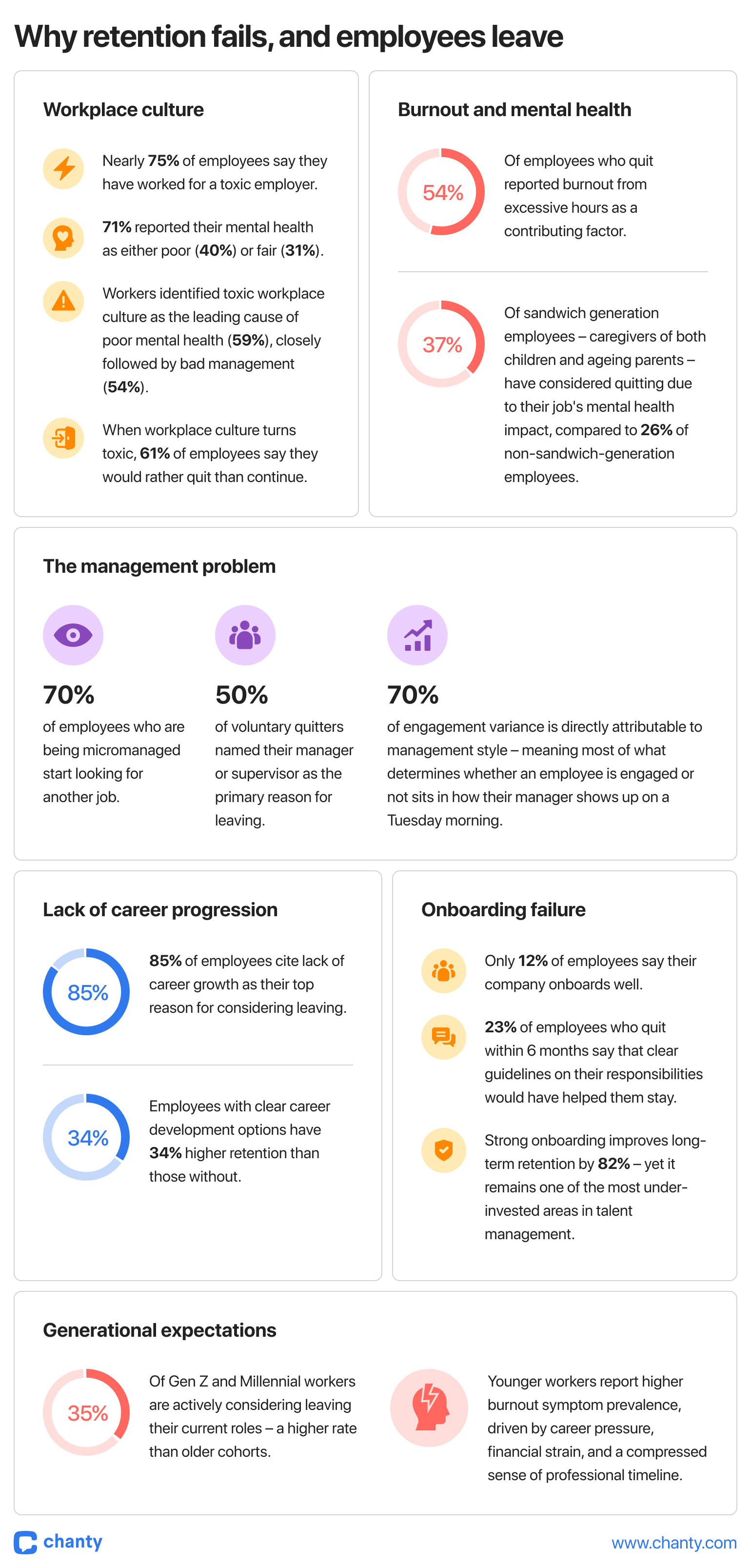
- Nearly 75% of employees say they have worked for a toxic employer
- 71% reported their mental health as either poor (40%) or fair (31%)
- Workers identified toxic workplace culture as the leading cause of poor mental health (59%), closely followed by bad management (54%)
- When workplace culture turns toxic, 61% of employees say they would rather quit than continue
Culture is not a background condition. It is the primary retention variable – and it is shaped, above all else, by the daily behavior of immediate managers.
Burnout and mental health as exit triggers
According to the 2026 NAMI-Ipsos Workplace Mental Health Poll, 84% of employees faced at least one mental health challenge in the past year – stress, burnout, or chronic low motivation. One in four employees said they had considered quitting specifically because of their job’s impact on their mental health.
The burnout picture is clearest among high-intensity demographics:
- 54% of employees who quit reported burnout from excessive hours as a contributing factor
- 37% of sandwich generation employees – caregivers of both children and aging parents – have considered quitting due to their job’s mental health impact, compared to 26% of non-sandwich-generation employees
- High workload intensity and constant time pressure are among the strongest predictors of emotional exhaustion, ahead of both compensation dissatisfaction and lack of recognition
When a workplace erodes your capacity to function, leaving is not failure. It is self-preservation.
The management problem hiding in plain sight
If there is one finding that runs through nearly every major employee retention study of 2026, it is this one: managers are the primary retention variable, and most organizations are not treating them as such.
According to Gallup, 71% of voluntary exits trace back to poor management, not pay. Nearly 70% of workers say they would quit over a bad manager. When asked what would actually make them stay, 68% said they would remain if their manager were better at engaging them daily.
The specifics are damning:
- 70% of employees who are being micromanaged start looking for another job.
- 50% of voluntary quitters named their manager or supervisor as the primary reason for leaving
- 70% of engagement variance is directly attributable to management style – meaning most of what determines whether an employee is engaged or not sits in how their manager shows up on a Tuesday morning
And recognition – the simplest, lowest-cost retention lever available – remains broadly unused. The Achievers Workforce Institute 2026 Engagement and Retention Report found that only 25% of employees feel genuinely appreciated at work. Those who do feel appreciated are 41 times more likely to be engaged with their manager.
Forty-one times. Not a marginal return. A different category of outcome entirely.
Most companies are not losing employees. They are losing managers’ influence over employees – and not noticing until someone hands in their notice.
Structural reasons employees are leaving
Beyond culture and management, a second layer of exit drivers operates at the system level. These are structural problems – harder to fix than recognition gaps, but equally measurable.
Lack of career progression is the most consistently cited structural driver:
- 85% of employees cite lack of career growth as their top reason for considering leaving
- Employees with clear career development options have 34% higher retention than those without
Onboarding failure represents an early and often irreversible retention failure:
- Only 12% of employees say their company onboards well
- 23% of employees who quit within 6 months say that clear guidelines on their responsibilities would have helped them stay
- Strong onboarding improves long-term retention by 82% – yet it remains one of the most under-invested areas in talent management
Generational expectations are reshaping what retention even means:
- 35% of Gen Z and Millennial workers are actively considering leaving their current roles – a higher rate than older cohorts
- Younger workers report higher burnout symptom prevalence, driven by career pressure, financial strain, and a compressed sense of professional timeline
- For these cohorts, flexibility and development aren’t benefits. They are baseline expectations.
The quiet quitting crisis: when leaving isn’t physical
Before talking about employees who quit, we need to talk about employees who stay but have already left in every meaningful sense.
Only 23% of employees globally describe themselves as engaged. The remaining 77% include a growing cohort of workers who are not actively job hunting – but are not contributing their full capacity either.
Gallup estimates this mass disengagement carries a price tag of $8.9 trillion in lost productivity – equivalent to 9% of global GDP. More than the combined economic output of Japan and Germany. Not lost to recession or disaster. Lost because workers stopped caring.
The 2026 Retention Report from Work Institute names the pattern directly: the “stay-but-disengaged” employee is now a larger retention risk than the one who actively job hunts. Their departure, when it finally comes, is sudden and hard to predict. There is no warning period. No counter-offer window.
What is quiet quitting?
Quiet quitting refers to employees who remain in their roles but withdraw discretionary effort – doing only the minimum required and nothing more. It is not laziness. Research consistently frames it as a rational response from workers who feel unheard, unsupported, and undervalued. In 2026, Gallup estimates that it affects the majority of the global workforce.
Only three in ten US employees are engaged enough to represent a genuine retention guarantee. The rest are watching, waiting, and calculating – often without their managers having any idea.
This is not turnover. It is pre-turnover behavior. And it is invisible until it isn’t.
What actually improves employee retention
If the previous sections mapped the reasons people leave, this section maps the terrain of loyalty. The research across 2026 sources delivers a consistent message: retention is built on culture, growth, and recognition – not perks.
Flexible work and autonomy
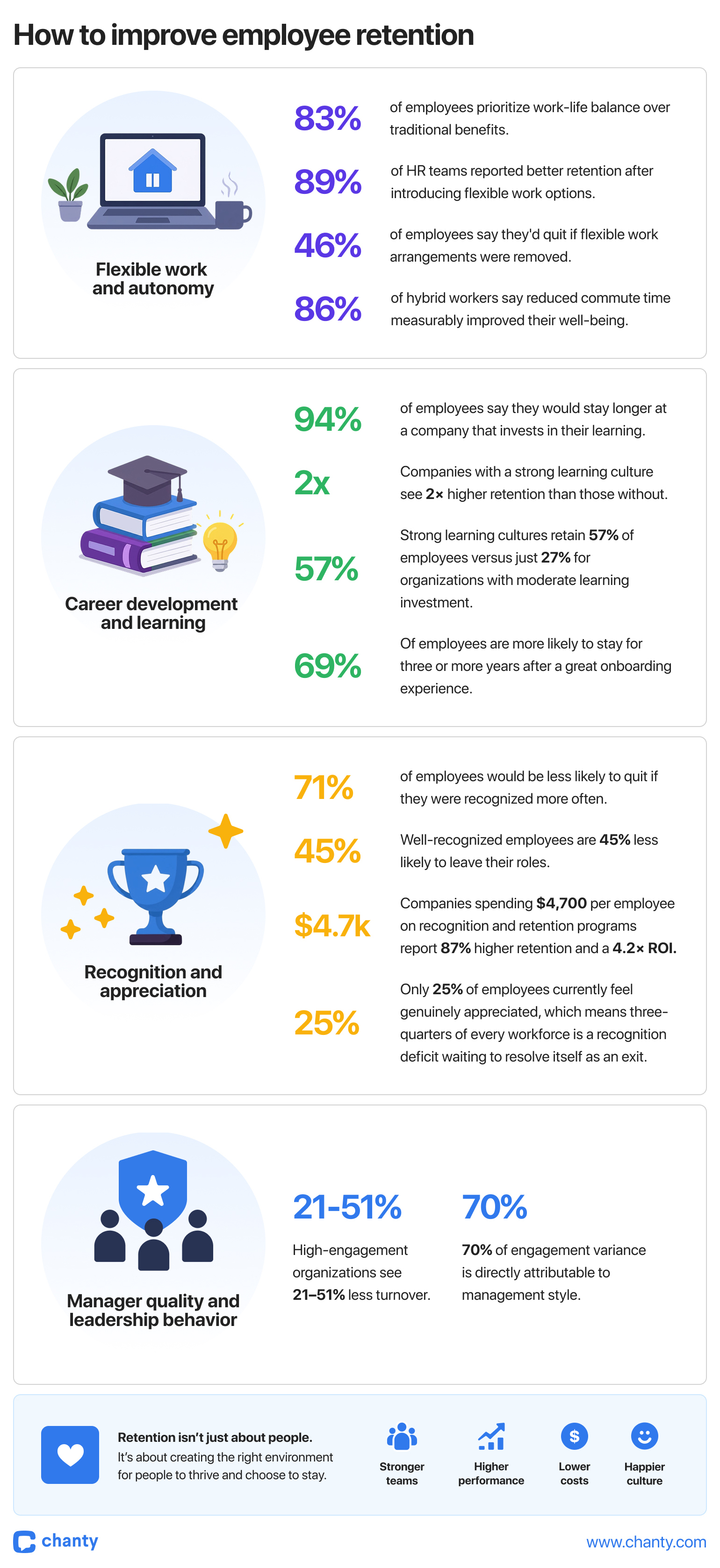
- 83% of employees prioritize work-life balance over traditional benefits
- 89% of HR teams reported better retention after introducing flexible work options
- 46% of employees say they’d quit if flexible work arrangements were removed
- 86% of hybrid workers say reduced commute time measurably improved their wellbeing
Flexibility is no longer a differentiator. It is the floor. Organisations that have pulled back on hybrid arrangements are not returning to normalcy – they are accelerating attrition among exactly the talent cohorts they most need to retain.
Career development and learning
- 94% of employees say they would stay longer at a company that invests in their learning
- Companies with a strong learning culture see 2× higher retention than those without
- Strong learning cultures retain 57% of employees versus just 27% for organizations with moderate learning investment
- 69% of employees are more likely to stay for three or more years after a great onboarding experience
The first 90 days are not orientation. They are a retention intervention – and the data on onboarding quality makes that unmistakably clear.
Recognition and appreciation
- 71% of employees would be less likely to quit if they were recognized more often
- Well-recognized employees are 45% less likely to leave their roles
- Companies spending $4,700 per employee on recognition and retention programs report 87% higher retention and a 4.2× ROI
- Only 25% of employees currently feel genuinely appreciated, which means three-quarters of every workforce is a recognition deficit waiting to resolve itself as an exit
Recognition is not a soft strategy. It is one of the highest-ROI levers available to any organization, and it is the one most consistently underused.
Manager quality and leadership behavior
- High-engagement organizations see 21–51% less turnover
- 70% of engagement variance is directly attributable to management style (Gallup)
- Coaching programs that build emotional intelligence, recognition habits, and communication quality in frontline managers have documented, measurable effects on attrition
- After implementing structured “Coaching Leadership Style” programs, organizations report significant improvements in rapport, trust, executive presence, and recognition quality
You don’t build retention programs. You build better managers. Everything else follows.
The cost of employee turnover
Replacement cost is only the beginning of the financial story. The full picture of employee turnover costs includes layers that most budget models don’t capture.
Direct costs are the easiest to measure:
- Job advertising, recruiter fees, background checks, assessment tools
- Onboarding materials, equipment provisioning, and access setup
- Formal training time and trainer bandwidth
Indirect costs are harder to quantify but larger in total:
- Lost productivity during the vacancy period (typically 1–3 months)
- Reduced team output while the new hire reaches competency (typically 6–12 months)
- Knowledge loss – institutional understanding that leaves with the employee and cannot be fully documented
Hidden costs are the ones that compound:
- Impact on the remaining employees’ workload, which elevates burnout risk in the team
- Declining morale when high performers watch colleagues leave and ask themselves why they’re still there
- Recruitment brand damage when voluntary departures become visible on review platforms
Mercer’s Global Talent Trends 2026 found that the share of employees who feel financially thriving dropped from 66% to 44% – falling below COVID-era lows. In response, 61% of employers provided off-cycle salary adjustments in 2025 specifically to retain employees. Of those, 75% were driven by retention concerns rather than performance.
Yet Gartner’s research reveals the deeper problem: only 32% of employees believe their pay is fair. Paying more without addressing culture and management doesn’t close the trust gap. It just makes the departure more expensive.
The real cost of employee turnover is not replacement. It is the system instability that follows – the cascading uncertainty that spreads through teams, degrades culture, and makes the next round of attrition more likely.
What companies that retain employees actually do differently
The research on high-retention organizations reveals a set of consistent practices that separate them from the field. These are not aspirational value statements. They are operational decisions.
They hold stay interviews, not just the exit ones. Stay interviews – proactive, structured conversations about what would make an employee leave and what keeps them invested – are now used by the top-performing organizations around the world. Exit interviews capture data after the decision is already made. Stay interviews capture it while there’s still time to act. The difference is not procedural. It’s strategic.
They track retention data with precision. Not just at the company level, but by manager, by role, by tenure cohort, by team. Because people rarely disappear without warning. The signals usually surface long before the resignation does – and organizations that are looking for them find them.
They develop managers as a retention strategy. Management quality is the single greatest predictor of voluntary turnover. High-retention organizations treat manager development not as a training line item but as a retention infrastructure investment – coaching emotional intelligence, recognition habits, and communication quality at the frontline.
They make career pathways visible and real. Employees with clear development options have 34% higher retention than those without. This doesn’t require large L&D budgets. It requires honest conversations, transparent promotion criteria, and structural clarity about what progression actually looks like in this organization – not what it looks like on a careers page.
They treat mental health as retention infrastructure. The 2026 NAMI-Ipsos Poll found that employees who feel comfortable discussing mental health with their manager are significantly more engaged and less likely to leave. Psychological safety is not a wellness initiative. It is a retention mechanism – and the organizations that build it early pay far less in turnover costs later.
They redesign work, not just rewards. The O.C. Tanner Institute found that 35% of employees feel depressed when thinking about their future at work, and only 52% feel hopeful. Hope – a genuine sense that this organization offers a future worth staying for – is now among the most powerful retention variables in the research literature. Perks don’t create it. Meaningful work, clear trajectory, and trusted leadership do.
The bottom line of employee retention statistics in 2026
The employee retention statistics in 2026 point to a consistent and increasingly hard-to-ignore pattern.
Employees are not leaving primarily because of compensation. They leave when they no longer feel seen, supported, or able to grow. When trust in management weakens, when growth feels unclear, when daily work stops providing any sense of forward motion – the psychological cost of staying begins to outweigh the practical cost of leaving.
This is why turnover often looks sudden in the data, while unfolding gradually in reality. By the time an employee resigns, the disengagement has usually been building for months. During that period, the impact may extend beyond retention: reduced effort, declining accountability, withdrawal from organizational goals, and, in some cases, counterproductive behaviours such as misuse of company resources or employee theft.
And this is where the Dobby metaphor becomes more than an opening device.
House elves in Rowling’s world are loyal, capable, and expected to serve indefinitely with little recognition or autonomy. Their continuity is assumed rather than earned. For much of modern employment history, the workforce functioned in a loosely similar way. Limited mobility, structural friction, and long-term employment norms meant people often stayed not because they were satisfied, but because leaving was harder than staying.
That structure no longer exists.
Modern employees are not bound to organizations. They can move, compare, and reassess at any moment. In that environment, loyalty is no longer inherited. It has to be continuously earned – through the quality of management, the clarity of growth, and the daily experience of feeling that what you do matters.
People do not stay where they are kept. They stay where they choose to belong.
FAQ
What is the average employee retention rate in 2026?
A healthy retention rate is around 90% (10% annual turnover). Rates vary widely by industry – from government positions at roughly 89% retention down to hospitality, where total turnover can reach 75%. Technology sits at approximately 76% retention with high replacement costs per employee.
What is the biggest reason employees leave their jobs?
Research consistently points to management quality and workplace culture – not pay. Toxic culture predicts attrition 10 times more accurately than compensation, and 71% of voluntary exits trace to poor management rather than salary dissatisfaction.
How much does it cost to replace an employee?
Replacement costs range from 30% to 400% of annual salary, depending on role and seniority. Globally, voluntary turnover costs companies approximately $2.9 trillion per year.
What keeps employees from leaving?
The highest-impact retention factors in 2026 are flexible work arrangements, visible career development, meaningful recognition, and strong frontline management. Engaged employees are 87% less likely to leave their current role.
What is quiet quitting, and how does it affect retention?
Quiet quitting describes employees who remain employed but disengage from discretionary effort. Gallup estimates it affects the majority of the global workforce and costs $8.9 trillion in lost productivity annually, making disengaged employees as significant a cost as those who leave outright.